The Open-Source AutoCAD Clone Built with AI Agents
CADCraft is an open-source AutoCAD clone on GitHub, built largely by AI coding agents in a few weeks. How the clean-room rules keep it legal, what the git history shows, how close it really is to AutoCAD, and where to get the source.
 CADCraft AI Editorial
Short answer: the open-source AutoCAD clone people mean is CADCraft, at github.com/storytold/cadcraft. It recreates AutoCAD's 2D workflow (type L, click two points, @5<45, Enter) in pure Rust, under MIT OR Apache-2.0. What makes it unusual is how it was made: mostly by AI coding agents, in about three weeks, under strict clean-room rules. Its first commit is dated 5 October 2026; version 0.14.0 shipped on 28 October with Windows, macOS, Linux, FreeBSD and browser builds.
It isn't a finished replacement. Its own roadmap calls it pre-alpha, about 38% ready for real work.
cadcraft.org is an independent guide, not the official site and not affiliated with Autodesk. CADCraft is made by the ArtCraft team (getartcraft.com/apps/cadcraft). Figures below come from the project's git history and documents as of 29 October 2026.
What the git history shows
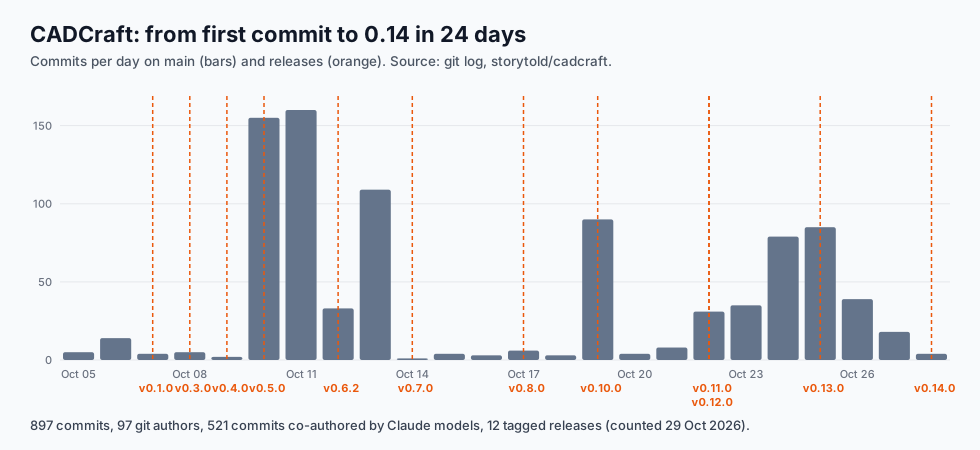
Counted from a full clone of the repository:
| Measure | Value |
|---|---|
| First commit | 5 October 2026 |
| Commits on main | 897 |
Commits with a Co-authored-by: Claude … trailer | 521 (58%) |
| Distinct git authors | 97 |
| Tagged releases | 12, from v0.1.0 (7 Oct) to v0.14.0 (28 Oct) |
| Rust source | about 216,000 lines in 12 crates and 3 apps |
| Pull request numbers reached | #2425 |
The trailers name several models (Claude Opus, Sonnet, Haiku and Fable versions). The project doesn't hide this: its About window has a Models tab that credits every AI model named in the commit trailers, next to a Contributors tab for people.
The commit bursts (155 and 160 commits on 10 and 11 October) are what agent-driven development looks like: many agents working in parallel on separate commands and fixes, each change landing as its own commit after checks pass. The roadmap even estimates remaining work in agent hours rather than developer months.
How you clone AutoCAD legally: clean-room rules
Cloning a commercial program's behaviour is old practice: compatible spreadsheets, office suites, and the PC BIOS were all built this way. Copying its code or assets is not allowed. CADCraft writes the line down in its AGENTS.md, the instructions every contributor and every AI agent works under:
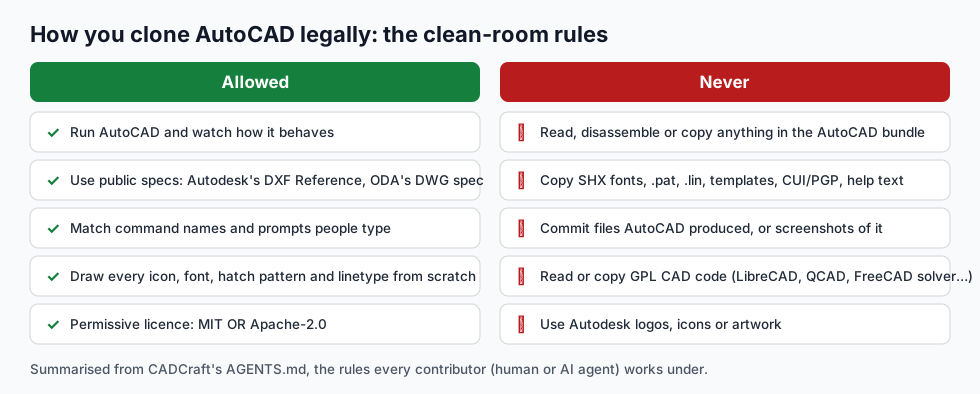
The rules worth noticing:
- Observe, never open. AutoCAD may be run as a black box with synthetic drawings to see how a command behaves. Nothing inside its application bundle may be read, disassembled or copied; file names may be listed, nothing more.
- Formats from public specs. DXF comes from Autodesk's own published DXF Reference; DWG from the Open Design Alliance's public specification. DWG reading and writing goes through the open-source
acadrustcrate. - Every asset is original. Icons are drawn in code. Hatch patterns, linetypes and the single-stroke drafting font are the project's own definitions; any file asset needs a row in
ATTRIBUTION.md, and a build task checks it. No SHX fonts,.pator.linfiles, templates or help text from Autodesk. - No GPL code either. Agents may not read the source of LibreCAD, QCAD, FreeCAD's solver, LibreDWG or OpenCASCADE, so nothing GPL-licensed can leak into a permissively licensed project.
- Same names, on purpose. Command ids are AutoCAD's command names in lower case (
line,dimlinear,arraypolar), so muscle memory, scripts and cheat sheets carry over.
This is general information, not legal advice; the rules are the project's own approach to staying on the right side of copyright and licences.
How close is the clone?
The project judges itself against the five workflows an AutoCAD professional does every day. Its verdict, in docs/roadmap.md:
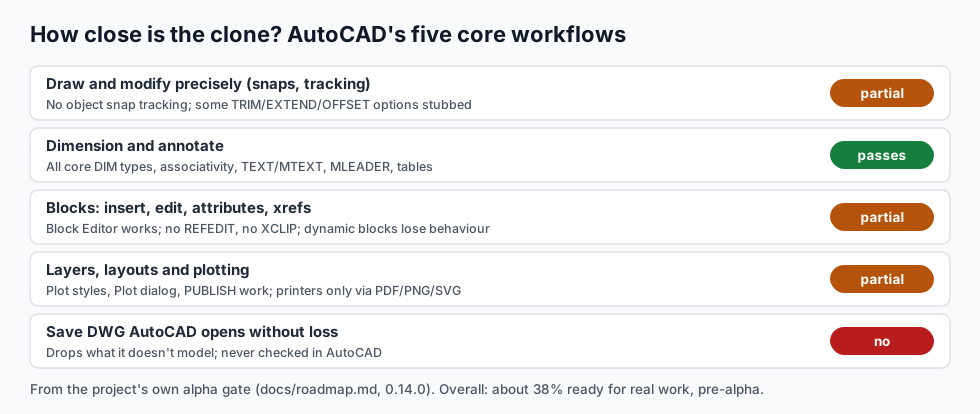
Other numbers from the same roadmap:
- 50% of AutoCAD for Mac's menu items have a working command (about 65% of the 2D menus).
- ≈ 38% "ready for real work" overall; ≈ 46% for an essentials user, ≈ 28% for a full-time 2D drafter, because file exchange and stability problems multiply.
- Remaining work to alpha is estimated at 125 to 190 agent hours, to full parity 1,300 to 2,100.
The weakest point is the one that matters most to professionals: saving DWG that AutoCAD reopens without loss. CADCraft drops what it doesn't model, and its DWG output has never been checked in AutoCAD. Use DXF for exchange today, and read DXF vs DWG for why.
What the clone does that AutoCAD doesn't
- Free and open. No account, no subscription, source on GitHub.
- Linux, FreeBSD and the browser, alongside Windows and macOS. Try it at cadcraft.org/online.
- Built for AI agents. An MCP server lets Claude and other clients type commands, query the drawing and render it; see AutoCAD AI agent with MCP.
- A scriptable CLI for headless conversion and batch jobs.
- Never-crash rules enforced by the compiler: no
unsafe, nounwraporpanic!in production code. CAD in Rust covers the architecture.
Get the source
git clone https://github.com/storytold/cadcraft
cd cadcraft
cargo run --release -p cadcraft -- --sample
You need Rust 1.95 or newer. Prebuilt, signed installers are on the download page and the GitHub releases page.
Searching GitHub for "autocad clone" also turns up other projects. Check how active each one is and what it can actually open and save. The mature open-source 2D tools, LibreCAD and QCAD, follow their own workflow rather than copying AutoCAD's. Open source CAD compared puts them side by side.
FAQ
Is there an open-source AutoCAD clone?
Yes. CADCraft (github.com/storytold/cadcraft) is an open-source 2D CAD program that copies AutoCAD’s workflow: the command names, prompts, aliases, object snaps, layers, layouts and plotting. It is MIT OR Apache-2.0 licensed and runs on Windows, macOS, Linux, FreeBSD and in the browser. It is pre-alpha.
Is it legal to clone AutoCAD?
Copying how software behaves (its commands and workflow) is generally allowed; copying its code, artwork, fonts or other files is not. CADCraft follows clean-room rules: contributors may watch AutoCAD run, but never read or copy anything inside it, and file formats come from public specifications. This is not legal advice.
Was CADCraft really built by AI?
Largely. Its first commit is dated 5 October 2026, and 521 of its first 897 commits on main carry a Co-authored-by trailer for a Claude model. Humans set direction, review and contribute too: git records 97 authors. The project credits AI models in its About window.
Can the AutoCAD clone replace AutoCAD?
Not yet for most professionals. By the project’s own measure it is about 38% ready for real work, and the biggest gap is saving DWG files that AutoCAD reopens without loss. It is useful today for 2D sketches, DXF work, scripting and AI-agent drawing.
Related
- CAD in Rust: the crates, the never-crash rules and measured speed
- AutoCAD AI agent with MCP: connect Claude to CADCraft
- Autodesk alternatives: a free option for every Autodesk product